

EngineeringTrending Career BLOGS Introduction Skills Required...
Read More
 Skip to content
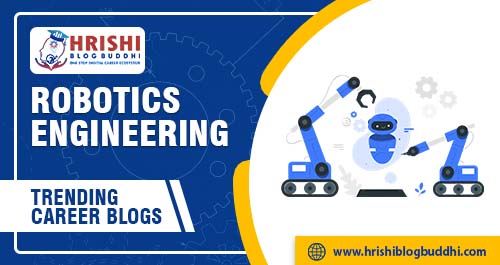
What is Robotics Engineering?” you may ask. Robotics Engineering stands at the forefront of innovation, combining electronics and mechanical engineering into a dynamic interdisciplinary field. This specialized course spans the entire spectrum of robot development, encompassing research, design, programming, operation, and modification. As we venture into the world of Robotics Engineering, a comprehensive understanding of three fundamental subjects is essential: Computer Science, Electrical Engineering, and Mechanical Engineering.
This evolving field is poised to revolutionize various industries in the upcoming decades, offering abundant job opportunities in sectors such as manufacturing, defense, and research. Whether you’re interested in pursuing a B.Tech or B.E. in Robotics Engineering or advancing to an M.Tech or M.E., a solid foundation in science and mathematics is paramount for prospective students.
The roles of Robotics Engineers are diverse, extending to both government and private sectors, where they contribute to the design and production of cutting-edge robotic systems. Moreover, opportunities abound for engineers to work as technicians in multinational automation firms. So, if you’re wondering “What is Robotics Engineering?” – it’s a field that’s shaping our future.
Internships play a crucial role in the development of aspiring electrical power engineering students. Acquiring real-life experience alongside theoretical knowledge is essential for their professional growth. While many internships within this field are typically unpaid, there are certain corporate internships that provide a stipend for the valuable contributions of the interns.
12th Standard | Graduation | Post-graduation | Doctoral programs |
Any educational board’s 10+2 exam must be passed by the candidate. | To pursue a career in this field, the candidate must have a bachelor’s degree. | If the candidates desire, they can also pursue a master’s degree. It is not required to pursue this option. | The candidates can also pursue a Ph.D. if they so wish. It is, however, not required to do so. |
The core subjects should include Physics, Chemistry, and Mathematics (PCM). | At the B.Tech. and B.E. levels, they can study robotics engineering. Maintain a 50-60 % average to be accepted into a post-graduate program. | They can pursue M.Tech, and M.E in robotics engineering. | They can pursue PhD. in the relevant field. |
The candidate should try to gain at least a minimum of 60% marks. Then, only they will become eligible for bachelor’s course | The candidate needs to pass the entrance exams like JEE, JEE Advanced, and others to get enrolled in a bachelor’s degree. | The candidate needs to pass the entrance exams like GATE and others to get enrolled in a master’s degree. | — |
College name | Location |
Indian Institute of Technology (IITs) | Different Locations in India |
National Institute of Technology (NITs) | Different Locations in India |
SRM Institute of Science and Technology (SRMIST) | Chennai |
Vellore Institute of Technology (VIT) | Vellore |
Roorkee Institute of Technology | Roorkee |
Delhi Technological University (DTU) | Delhi |
Lovely Professional University (LPU) | Jalandhar |
Birla Institute of Technology (BITS) | Pilani |
AMC Engineering college | Banglore |
Anna University | Chennai |
For admission to colleges offering Robotics Engineering, candidates can take the following entrance exams:
Exam Name | Conducting Body | Duration | Frequency |
JEE Mains – Joint Entrance Exam Mains | National testing agency (NTA) | 3 hours | Twice a year |
JEE Advanced- Joint Entrance Exam Advanced | Indian Institute of Technology (IITs) | 3 hours | Once a year |
GATE- Graduate Aptitude Test in Engineering | Indian Institute of Technology (IITs) | 3 hours | Once a year |
Exam Name | Conducting Body | Duration | Frequency |
REAP (Rajasthan Engineering Admission Process) | Rajasthan Technical University (RTU) | 3 hours | Once a year |
WBJEE (West Bengal Joint Entrance Examination) | West Bengal Joint Entrance Examinations Board | 2 hours | Once a year |
UPCET (Uttar Pradesh Combined Entrance Test) | National Testing Agency (NTA) | 3 hours | Once a year |
KCET (Karnataka Common Entrance Test) | Karnataka Examinations Authority | 1 hour 30 minutes | Once a year |
KEAM (Kerala Engineering Agricultural Medical Entrance Exam) | Commission of Entrance Examination (CEE) | 2 hours 30 minutes | Once a year |
TS EAMCET (Telangana State Engineering, Agriculture and Medical Common Entrance Test) | JNTU Hyderabad | 3 hours | Once a year |
AUCET (Andhra University Common Entrance Test ) | Directorate of Admission Andhra University | 1 hour 30 minutes | Once a year |
MHT CET(Maharashtra Common Entrance Test) | Maharashtra Common Entrance Test Cell | 2 hours 30 minutes | Once a year |
Exam Name | Conducting Body | Duration | Frequency |
BITSAT (Birla Institute of Technology and Science Admission) | BITS Pilani | 3 Hours | Once a year |
VITEEE (Vellore Institute of Technology Engineering Entrance Examination) | VIT University, Vellore | 1 hour 30 minutes | Once a year |
SRMJEEE (SRM Joint Engineering Entrance Exam) | SRM Institute of Science and Technology | 2 hour 30 minutes | Once a year |
LPU NEST (Lovely Professional University National Eligibility and Scholarship Test) | Lovely Professional University | 2 hour 30 minutes | Twice a year |
Robotics Engineering graduates engage in various activities within this dynamic field, including:
Job Name | Job Description |
Robotics Engineer | They are responsible for the design and maintenance of robots and their electronic systems. They work in the manufacturing industry as well as in the office. They work on robot systems, attempting to improve and improve their technology. |
Robotic Process Automation Engineers | They are in charge of designing, creating, and implementing software robots, or bots, that work alongside humans to improve business process efficiency. |
Robotics Technician | Their job includes troubleshooting a variety of robotic systems. They have a wide range of technical abilities and knowledge to program and fix the robot’s motions and actions, as well as the equipment, controllers, and other components. |
Robotics Welding Engineer | Welding is a crucial task in the robotics industry because most of the robot’s parts are welded together. The welding process is overseen by a welding engineer. |
Robotics Research Scientist | They are in charge of doing robotic system research, design, and development. They make sure the robots are dependable, safe, and economical. |
Robotics Programmer | They are in charge of developing, creating, and executing robotic technology-assisted business processes. They’re also in charge of keeping track of a robot’s production. |
The following are some top companies who recruit graduates of Robotics Engineering-
EngineeringTrending Career BLOGS Introduction Skills Required...
Read MoreEngineeringTrending Career BLOGS Introduction Skills Required...
Read MoreENGINEERING Trending Career BLOGS Introduction Skills...
Read MoreEngineeringTrending Career BLOGS Introduction Skills Required...
Read More