
EngineeringTrending Career BLOGS Introduction Skills Required...
Read More
 Skip to content
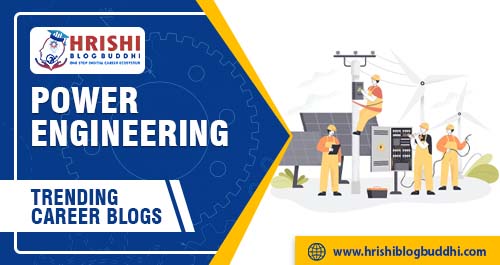
What is Electrical Power Engineering? It’s a specialized branch within the broader field of electrical engineering, focusing on the generation, transmission, distribution, and utilization of electric power. This discipline plays a pivotal role in various industries, demanding skilled professionals capable of designing and maintaining electrical systems and devices. The field offers a plethora of career opportunities in electrical engineering, making it an attractive choice for those interested in the dynamic world of power engineering. So, if you’re asking, “What is Electrical Power Engineering?”, it’s all about this exciting field.
Power engineers are essential in sectors dealing with electricity generation, transmission, and distribution, as well as the design and development of electrical devices. The demand for professionals with expertise in electrical power engineering is on the rise, and the field presents numerous avenues for growth and specialization. So, when someone asks, “What is Electrical Power Engineering?”, it’s about these opportunities and advancements.
12th Standard | Graduation/Diploma | Post-Graduation/ Diploma |
The candidate must have appeared in 10+2 from any educational board. | The candidate should have a bachelor’s degree to pursue a career in this field. | The candidates can also pursue a master’s degree if they want to. Although it is not necessary to go for this. |
The core subjects should include Physics, Chemistry, and Mathematics (PCM). | The candidate needs to pass the entrance exams like JEE, JEE advanced and others to get enrolled in a bachelor’s degree. | They can pursue M.Tech, M.E., and M.Phil in power engineering. |
The candidate should try to gain at least a minimum of 50-60% marks. Then, only they will become eligible for bachelor’s course | They can pursue B.Tech, B.E. in power or electrical engineering. Try to maintain at least 50-60% to get admission in post-graduation. | The candidate needs to pass the entrance exams like GATE and others to get enrolled in a master’s degree. |
Internships are necessary for the students of the electrical power engineering field. The aspirants should have real-life experience with theoretical knowledge. The majority of internships are unpaid, certain corporate internships do offer a stipend.
College name | Location |
Indian Institute of Technology (IITs) | Different Locations in India |
Birla Institute of Technology (BITS) | Pilani |
National Institute of Technology (NITs) | Different Locations in India |
Vellore Institute of Technology (VIT) | Vellore |
SRM Institute of Science and Technology (SRMIST) | Chennai |
Delhi Technological University (DTU) | Delhi |
College of Engineering | Pune |
UPES | Dehradun |
AMC Engineering college | Banglore |
Anna University | Chennai |
Manipal Institute of Technology(MIT) | Karnataka |
NPTI | Delhi |
Sardar Patel College of Engineering | Mumbai |
The candidates need to pass the entrance examination to get admission to universities or colleges.
Exam Name | Conducting Body | Duration | Frequency |
JEE Mains – Joint Entrance Exam Mains | National testing agency (NTA) | 3 hours | Twice a year |
JEE Advanced- Joint Entrance Exam Advanced | Indian Institute of Technology (IITs) | 3 hours | Once a year |
GATE- Graduate Aptitude Test in Engineering | Indian Institute of Technology (IITs) | 3 hours | Once a year |
Exam Name | Conducting Body | Duration | Frequency |
WBJEE (West Bengal Joint Entrance Examination) | West Bengal Joint Entrance Examinations Board | 2 hours | Once a year |
UPCET (Uttar Pradesh Combined Entrance Test) | National Testing Agency (NTA) | 3 hours | Once a year |
KCET (Karnataka Common Entrance Test) | Karnataka Examinations Authority | 1 hour 30 minutes | Once a year |
AUCET (Andhra University Common Entrance Test ) | Directorate of Admission Andhra University | 1 hour 30 minutes | Once a year |
TS EAMCET (Telangana State Engineering, Agriculture and Medical Common Entrance Test) | JNTU Hyderabad | 3 hours | Once a year |
MHT CET(Maharashtra Common Entrance Test) | Maharashtra Common Entrance Test Cell | 2 hours 30 minutes | Once a year |
Exam Name | Conducting Body | Duration | Frequency |
BITSAT (Birla Institute of Technology and Science Admission) | BITS Pilani | 3 Hours | Once a year |
VITEEE (Vellore Institute of Technology Engineering Entrance Examination) | VIT University, Vellore | 1 hour 30 minutes | Once a year |
SRMJEEE (SRM Joint Engineering Entrance Exam) | SRM Institute of Science and Technology | 2 hour 30 minutes | Once a year |
The role of a power and electrical engineer encompasses a broad spectrum of activities, including:
Job name | Job description |
Electrical engineer | To harness the power of electrical energy and radiation, electrical engineers design methods, equipment, and systems. |
Power engineer | Engineers who design, develop, or manage the installation of electrical equipment, components, or systems for commercial, industrial, or utility products are known as power engineers. |
Project engineer | Schedule preparation, pre-planning, and resource forecasting for engineering and other technical activities linked to the project are all responsibilities of a project engineer. |
Field engineer | Field engineers solve difficulties in manufacturing plants by applying scientific, engineering, and mathematical theories. They assist in the proper operation of the manufacturing units. |
Product design engineer | Designing, programming, simulation, and testing automated machinery and procedures to execute precise tasks are all part of the work. They are most commonly found in industries where robots or machines are used to execute specialized tasks. |
Professor | They carry out research, fieldwork, and investigations as well as writing reports. Publishing research, attending conferences, giving lectures, and networking with others in the electric sector are examples of these types of electrical power jobs. |
Control & Instrumentation Engineer | They are in charge of equipment design, development, installation, management, and maintenance. Engineering systems, machinery, and processes are monitored and controlled using instruments. |
Research scientist | Research scientists are scientists who are in charge of planning, carrying out, and interpreting data from laboratory-based investigations, experiments, and trials. |
Materials scientist | Materials scientists are in charge of figuring out how to strengthen or combine materials, as well as developing new materials for application in a wide range of products. |
Maintenance engineer | The Maintenance Engineer is in charge of ensuring that the installed electrical plant and equipment are in good operating order. They will be responsible for repairing any issues or breakdowns using the company’s maintenance workers. |
Design manager | To interpret the customer’s requirements, the design engineer will typically meet with clients and other trade specialists. They create the design specification, which will let the project’s cost be calculated. |
Power engineering graduates find opportunities with prominent companies, including
EngineeringTrending Career BLOGS Introduction Skills Required...
Read MoreEngineeringTrending Career BLOGS Introduction Skills Required...
Read MoreENGINEERING Trending Career BLOGS Introduction Skills...
Read MoreEngineeringTrending Career BLOGS Introduction Skills Required...
Read More